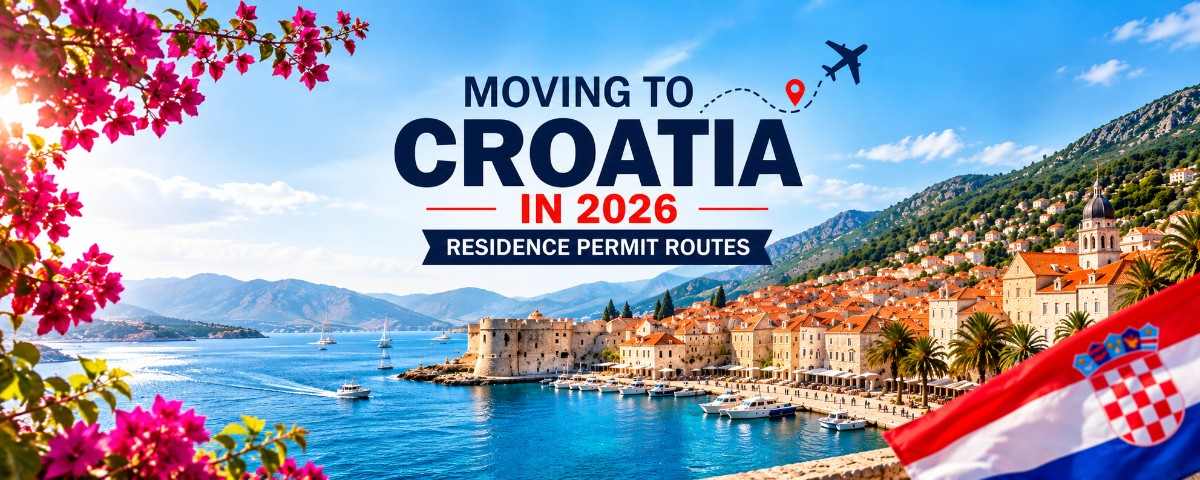
Croatia’s immigration rules changed materially in 2025 and again in 2026. That matters, because a great deal of the English language information available online still describes rules that no longer exist, blends different residence categories together, or presents administrative practice as though it were legislation.
The current Aliens Act contains several Croatia residence permit routes that work very well for non EU nationals. They work for different people, however, and they should not be confused with one another. What follows is the position as it actually stands, written by a lawyer who files these applications.
One preliminary correction on tax, since it appears in almost every article on the subject. Croatia applies a 10 percent corporate profit tax rate to taxpayers below the statutory revenue threshold, currently one million euros. That is a rate applied to taxable profit, not a tax on turnover. Residence, personal taxation and company taxation are three separate questions and should be planned separately.
ROUTE ONE: THE DIGITAL NOMAD PERMIT
The best-known Croatian route, and still the most frequently misunderstood.
It is available to third-country nationals who work remotely through communication technology, for a company or through their own company, that is not registered in Croatia. The status does not permit work for, or the provision of services to, Croatian employers.

The Croatia residence permit may be granted for up to eighteen months. Where it is initially granted for a shorter period, an extension may be possible within that framework, and the extension application must be filed no later than sixty days before expiry. A fresh application cannot simply follow the previous one, as the law imposes a six-month waiting period after expiry.
For 2026 the financial threshold is 3,622.50 euros per month. That figure is two and a half times the official average monthly net salary for 2025, which was 1,449 euros. For each additional family member or partner, the requirement increases by 10 percent of that average salary, currently 144.90 euros per person, and not by 10 percent of the nomad threshold itself. That distinction is routinely reported incorrectly and makes a substantial difference to a family of four.
Croatia recognises Revolut as a lawful means of payment and banking. That matters because it means a person relocating here can operate through an online account from day one, without the delay of opening a local account and without needing to attend a branch in person. A local account can follow later, whenever it becomes useful.
Know more – 10 Compelling Reasons to Become an Expat in Zagreb, Croatia
There are several ways to evidence the funds. The Ministry of the Interior accepts a bank statement showing the total amount required for the intended stay, a bank statement showing regular monthly income, or at least six months of payslips. For a twelve-month stay, the lump sum figure is 43,470 euros; for eighteen months, 65,205 euros.
The status carries a genuine Croatian income tax advantage, but it should be stated precisely. Croatian law exempts qualifying receipts earned from work or activity for an employer not registered in Croatia, on the basis of digital nomad status. That is not the same as saying that every category of foreign source income is exempt. Dividends, rental income and capital gains require their own analysis, and an applicant who assumes otherwise may be unpleasantly surprised.
One further misconception is worth correcting expressly. This is not a passive income or wealth visa. A substantial bank balance can satisfy the financial evidence requirement, but it does not replace the underlying condition that the applicant actually falls within the statutory definition of a digital nomad. If you do not work remotely, savings alone will not qualify you.
Finally, a point on which older explanations should be treated carefully. Under the Aliens Act currently in force, digital nomad residence is not expressly listed among the periods excluded from the five-year calculation for EU long-term residence. It is therefore too broad to say that none of the time ever counts. What is accurate is that this status cannot by itself be maintained for five continuous years, given its maximum duration and the six-month rule that follows it. An applicant who intends to settle permanently should plan a timely transition to another qualifying basis, rather than attempt to chain permits.
The Croatia digital nomad permit is an excellent way to begin living in Croatia. It is not a self-contained path to permanent residence.
ROUTE TWO: RENEWABLE RESIDENCE FOR RETIRED PROPERTY OWNERS OVER 60
This is the most significant recent change for people intending to retire to Croatia, and it is almost unknown outside the country.
Since the 2025 amendments, a retired third-country national over 60 who owns real estate in Croatia falls within a special statutory exception allowing temporary residence granted for other purposes to be renewed. The exception expressly covers the person’s spouse, common law spouse, life partner or informal life partner.
Each element of that description matters, and this is where most summaries go wrong. It is not sufficient to be over 60. It is not sufficient to be financially independent. The provision refers to a retired person, over 60, who owns property. All three conditions apply together.
There is no immigration provision imposing a minimum purchase price, so there is no threshold of 250,000 or 500,000 euros as under comparable arrangements elsewhere. The applicant must nevertheless satisfy the ordinary conditions for temporary residence, including a valid travel document, means of subsistence, health insurance and the other statutory requirements. For residence granted for other purposes, the current subsistence requirement is 60 percent of the previous year’s average monthly net salary, which on 2026 figures is 869.40 euros per month.
The absence of a price threshold should not be confused with an unrestricted right to buy. Acquisition of Croatian property by third country nationals can depend on reciprocity and, where applicable, on the consent of the competent ministry, and the position differs materially by nationality. The Ministry of Justice publishes an official country-by-country position, and it changes. Australian nationals, to take a current example, face a restriction on acquiring existing property that runs until 2027, subject to exceptions. Reciprocity should therefore be checked before a purchase is structured, not after.
There is also a family limitation that is rarely mentioned. The statute gives the renewal exception to the owner’s spouse and the specified partners, but holders of ordinary residence for other purposes are generally excluded from the standard family reunification route. This Croatia residence route should not be presented as covering every dependent family member without checking each person’s separate legal basis.
What makes the provision genuinely significant is its treatment for long-term residence. As a general rule, time spent on a permit granted for other purposes is excluded from the five-year calculation. The legislature created an express exception for this category of retired property owner, so their qualifying period is brought back into that calculation. That makes the route considerably more than a convenient annual arrangement.
ROUTE THREE: SELF-EMPLOYMENT THROUGH YOUR OWN CROATIAN COMPANY
For someone who genuinely intends to establish and operate a Croatian business, the self employment provisions offer a renewable work and residence basis outside the ordinary labour market test model.
The conditions are substantial. For a third country national self-employed in a company or trade of which he is the sole owner, the Act requires an investment of at least 26,544.56 euros in establishing the business. At least three Croatian citizens must be employed on an indefinite, full-time basis, each at a gross salary of at least the previous year’s Croatian average. The owner’s own gross remuneration must reach at least one and a half times the relevant average gross salary.
The Act also addresses majority ownership directly: a third-country national holding at least 51 percent of a Croatian company or trade must regularise residence and work under these self-employment rules.
This is an operating business route, not a paper company. The employment obligations create a real and recurring cost, and that cost should be calculated before anything is incorporated. What the route does offer is independence: an entrepreneur who genuinely wants to operate from Croatia does not need to find an unrelated Croatian employer willing to sponsor a work permit.
A word of caution about the EU Blue Card, which is frequently misdescribed. Croatia issues Blue Cards for up to forty eight months to qualifying highly skilled workers. The route requires a qualifying employment contract of at least six months, the prescribed salary level, and relevant higher education qualifications or, in the categories the legislation allows, qualifying high level professional skills. The 2025 reform opened an experience based route for specified IT professionals.
The Blue Card is a genuine option for a highly qualified person employed by a Croatian company. It should not, however, be presented as a simple way for a majority owner to establish his own company and bypass the self-employment conditions. The Act expressly directs persons holding at least 51 percent into the self-employment regime, while the Blue Card is a separate high-skilled employment regime with its own requirements. A shareholder employment structure may warrant individual analysis, but it is not a general substitute for the three employee requirement.
WHAT HAPPENS AFTER FIVE YEARS
This is where planning matters more than the first Croatia residence permit.
EU long term residence may generally be granted after five years of uninterrupted qualifying residence. That is not simply a matter of elapsed time. Under the ordinary rule, absences may not exceed ten months in total, and no single absence may exceed six months, within the relevant period. Applicants must also satisfy requirements concerning means, health insurance, knowledge of the Croatian language and Latin script, and the absence of security obstacles.
The self employment route is not among the categories excluded from that calculation. The retired property owner route is clearer still, since the Act expressly provides that time under the over 60 provision counts. Digital nomad time is likewise not listed among the exclusions, but as explained above, that status cannot practically be sustained across five years.
Citizenship is a separate legal question, and it should not be presented as an automatic conversion. Ordinary naturalisation under the Croatian Citizenship Act requires, among other conditions, eight years of uninterrupted registered residence in Croatia up to the date of application, the permanent status condition set out in that Act, compliance with the foreign citizenship requirement or an applicable exception, respect for the Croatian legal order, settled public liabilities and the absence of security obstacles. The language, script and culture requirement also applies, although persons over 60 are exempt from that particular condition.
In short, neither buying property nor forming a company buys Croatian citizenship. These are ordinary residence provisions. Long term residence and eventual naturalisation are later stages with their own conditions, and they should be planned as such.
That distinction became more important after the judgment of the Court of Justice of the European Union of 29 April 2025 in Commission v Malta, where the Court held that granting nationality, and therefore Union citizenship, in direct exchange for predetermined investments or payments was incompatible with EU law. The Croatian routes described here are different in kind: they are residence provisions subject to continuing statutory conditions, not investment arrangements.
THE PRACTICAL POINTS THAT CAUSE AVOIDABLE PROBLEMS
Health insurance should be addressed route by route. For digital nomads, the Ministry expressly requires travel or private health insurance covering Croatia for the entire intended period of residence. A short holiday policy will not satisfy an eighteen month application, and policies issued domestically often do not extend to residence abroad. Where a family relocates, each person requires coverage. Employment based categories operate differently, and for the EU Blue Card the qualifying employment contract is itself recognised as evidence of insurance. This is one of the few requirements that cannot be resolved at the last minute, so it is worth arranging early, with a provider that understands expatriate coverage.

Accommodation is more nuanced than most guides suggest. A first-time digital nomad applicant who does not yet have a permanent Croatian address may give a temporary hotel or hostel address supported by a confirmed reservation. After arrival, actual residence must be registered with the police, using a lease, title deed or owner’s statement. These are two different stages, not competing rules, and conflating them causes unnecessary anxiety.
Criminal record evidence should be ordered with the specific category and issuing country in mind. For digital nomads, the Ministry requires evidence of no final conviction from the country of nationality, or from a country where the applicant lived for more than one year immediately before coming to Croatia, legalised under the applicable rules. Digital nomad documents are accepted in Croatian or English, with an authorised translation where required.
Do not assume that the choice between an apostille and fuller legalisation can be settled simply by checking whether a country is party to one convention. Applicable international agreements and country-specific rules must be checked before the certificate is issued and authenticated.
Where the application is filed depends on the applicant’s visa status and the residence ground. As a general rule, an application is filed through a Croatian diplomatic mission or consulate, while a third country national who does not require a short stay visa may also apply at the competent police administration in Croatia while lawfully present. Statutory exceptions apply to some visa-required applicants. Digital nomads also have a dedicated online procedure, but a visa-required applicant whose residence is approved must still follow the applicable long-stay visa procedure before travelling.
There is no single processing time that applies across all three routes. Document collection, nationality, legalisation, property acquisition and the type of application all affect the sequence. Where the legislature sets a specific period, it is stated as such: the Act provides sixty days for a decision on a duly completed EU Blue Card application.
A FINAL WORD
Croatia’s residence system is not particularly complicated, but it is exact.
The expensive mistakes are rarely dramatic. They are small sequencing errors: buying property before checking reciprocity, assuming that savings turn a person into a digital nomad, incorporating a company before calculating the mandatory employment cost, relying on a tax exemption more broadly than the statute allows, or letting a temporary status expire before the next basis is properly structured.
The right question is therefore not which Croatian permit you can obtain today. It is which status fits what you actually intend to do here, and where you want that status to lead in five or eight years.
That is worth settling before the move, not after it.
About the Author
 Ivan Župan is a senior partner at Župan & Antunović Law Firm in Zagreb. The firm advises international clients on residence, citizenship, property and corporate matters in Croatia and Slovenia, working in English throughout.
Disclaimer
This article is general information based on Croatian legislation and published administrative guidance as at August 2026. It is not legal or tax advice. Financial thresholds, documentary requirements and country-specific rules change, and nationality, family circumstances, tax residence and immigration history can materially affect the outcome in an individual case. This website takes no responsibility for the accuracy of the content, and we recommend that you obtain advice on your own unique situation and needs from a professional.